I had the chance to be at AI Summit Barcelona on 22 and 23 September. And I confess that I saw a lot of keynotes in a short time. All with different ideas and interesting real-life cases. But when it finished, I thought about everything I’d heard and asked myself.. what did I learn? Was it worth it?
The AI paradox
During the event, something surprised me. Three different keynotes showed the same figures. They came from McKinsey’s The State of AI report.
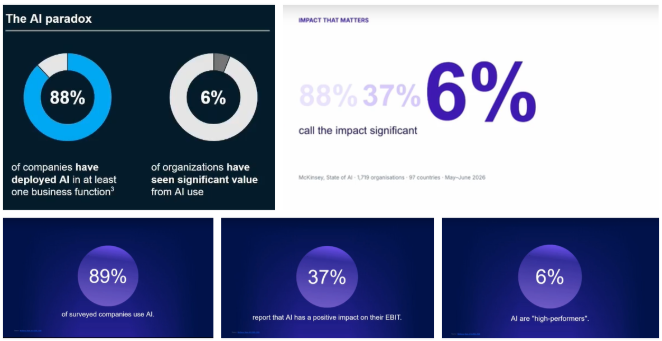
88% of organisations use AI. 37% report some impact on their profits (EBIT). And only 6% see a significant impact. So, I reorganised everything I’d seen around a single question: what makes this 6% of organisations different?
I found three “obstacles” that explain why most organisations don’t see real results. And a solution for each one.
First obstacle: believing in magic
AI is a powerful tool, so it’s easy for everyone to think it’s magic. But today there are still some real problems that haven’t been solved:
- False information: according to NewsGuard, the 10 leading AI chatbots repeated false claims on news topics 35% of the time.
- Uncontrolled costs: some companies burn through their annual AI budget in a few months. Uber spent its entire 2026 budget for AI coding tools in four months.
- Not good for every problem: AI gets incredible results in coding. But on Agents’ Last Exam, a benchmark of more than 1,500 real-world tasks, even the best AI agents fully complete fewer than 4 in 10.
Second obstacle: using AI without context
Without context, answers are generic. According to Harvard Business Review, models without context produce generic texts that aren’t useful. The value comes when they’re combined with your own data.
Having the latest model doesn’t make the difference anymore. In fact, an open model with context can get results almost as good as the latest-generation one.
Third obstacle: working the same way, but with AI
This is the hardest obstacle to see: if we don’t change how we work, the result won’t change.
Imagine a process to produce a case file. Someone writes a report, and then it goes through five approvals. With AI, writing it goes from 2 hours to 10 minutes. Great. But the approvals still take 3 weeks. We’ve saved two hours in a three-week process.
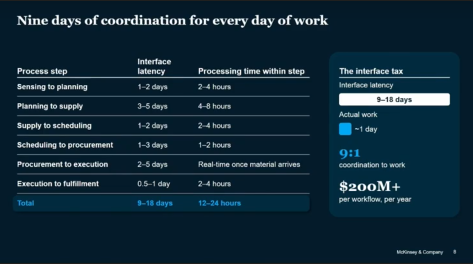
And this happens more often than you think. Steffen Fuchs from McKinsey explained that in a typical process, for every day of real work there are between 9 and 18 days of waiting: waiting for someone to review it, approve it or pass it from one team to another. AI speeds up the work, but not the waiting.
First solution: measuring
So how do you stop believing in magic? By measuring. Before rolling AI out, there are three questions you need to answer with numbers:
- Does it get things right? With evals built on real cases from your own work, you can get your chatbot to answer well. And prove it.
- What does it cost, and what does it bring us? Cost only makes sense when you look at it next to the impact on the business. Jeff Gothelf, co-author of Lean UX, puts it well: an outcome is a measurable change in what people do that drives business results. So instead of counting how many credits each call costs, ask yourself: what business result has this changed?
- Where does it make the difference? We’ve already seen that AI shines at coding but gets stuck on many real-world tasks. You need to know where it gets things right and where it doesn’t, and only use it where it shines.
Second solution: giving context
A model doesn’t know your organisation: not your data, not your rules, not your exceptions. All of that is part of the harness: the setup of data, tools, security and rules that makes AI useful.
And this context can grow. Every time someone corrects an answer, that correction can be used to improve the system. As Jaime de Mora from Microsoft put it, every correction we don’t save is knowledge we lose.
Third solution: rethinking processes
If we only add AI to one step and the rest of the process stays as it is, nothing really changes. The real change comes when we rethink the whole process. And very often, rethinking it means taking things out: reviews that add nothing, back-and-forth loops and steps that no longer make sense.
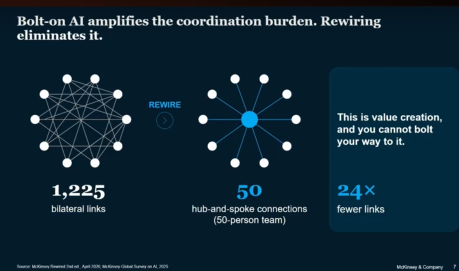
Toyota did it with production planning. According to Deloitte, it used to take around 75 spreadsheets, more than 50 people and hours and hours of work. With AI agents, the team is down to 6 to 10 planners, and they get planning models in minutes. They didn’t add AI to one step. They changed the way they work.
From human in the loop to human in the lead
In recent years, the idea of human in the loop has become very popular: people are a small piece of a big process run by AI. But here we’re going one step further. It’s about putting the human in the lead, a person in charge, able to:
- Measure with judgement. Know what change we want to see in the business, and check whether AI is achieving it.
- Give context and wisdom. The rules, the exceptions and everything that isn’t written in any manual. AI will shine if it knows our organisation.
- Rethink the business and how we do things. Adding AI to the way we already work changes very little. The impact comes when we redesign the work around it.
This post comes from the talks by Florian Kunzke, Christian Rebernik, Jaime de Mora, Steffen Fuchs, Jeff Gothelf, Nicky Verd and Luc Julia at AI Summit Barcelona 2026.
Related reading: why prompt instructions are not governance.